







Focus Keywords (naturally optimized)
- Java constructor
- types of constructor in Java
- parameterized constructor in Java
- constructor chaining in Java
- this() and super() in Java
- Java constructor example
Introduction: Why Java Constructors Matter
In Java, constructors play a crucial role in object creation. Whenever you create an object using the new keyword, a constructor is automatically called to initialize that object. Understanding constructors deeply is essential for OOP concepts, interview preparation, and real-world Java development.
This blog explains Java constructors from basics to advanced, including types of constructors, parameterized constructors, and constructor chaining using this() and super(), with clear examples.
What Is a Constructor in Java?
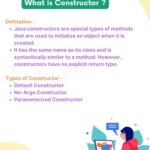
A constructor in Java is a special block of code that is executed when an object of a class is created.
Key Characteristics of Java Constructors
- Constructor name must be the same as the class name
- Constructors do not have a return type
- Called automatically when an object is created
- Used to initialize object data
Simple Definition
A Java constructor is a special method used to initialize objects at the time of object creation.
Why Do We Need Constructors in Java?
Constructors help to:
- Initialize instance variables
- Assign default or custom values
- Ensure object consistency
- Reduce repetitive initialization code
Without constructors, you would have to manually assign values every time after creating an object.
Types of Constructors in Java
Java mainly supports three types of constructors:
1. Default Constructor
A default constructor is automatically provided by Java if no constructor is written in the class.
Features:
- Has no parameters
- Initializes variables with default values
- Created by the compiler
Example:
class Student {
    int id;
    String name;
}
Java internally creates:
Student() {
}
2. No-Argument Constructor
A no-args constructor is explicitly created by the programmer and does not accept parameters.
Example:
class Student {
    Student() {
        System.out.println("No-arg constructor called");
    }
}
Use Case:
- When you want to perform some action during object creation
- Logging, setup tasks, default initialization
3. Parameterized Constructor in Java
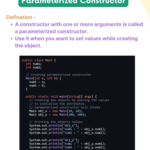
A parameterized constructor accepts one or more arguments and initializes the object with provided values.
Why Use Parameterized Constructor?
- To assign custom values during object creation
- To avoid setters immediately after object creation
Example:
class Student {
    int id;
    String name;

    Student(int i, String n) {
        id = i;
        name = n;
    }
}
Object Creation:
Student s1 = new Student(101, "Amit");
Student s2 = new Student(102, "Neha");
Each object gets different values, making the program flexible and reusable.
Constructor Overloading in Java
Java allows multiple constructors in the same class with different parameter lists. This is called constructor overloading.
Example:
class User {
    String name;
    int age;

    User() {
        name = "Guest";
        age = 0;
    }

    User(String n, int a) {
        name = n;
        age = a;
    }
}
Constructor Chaining in Java
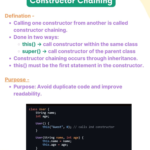
Constructor chaining means calling one constructor from another constructor.
This helps to:
- Avoid duplicate code
- Improve readability
- Maintain centralized initialization logic
Ways to Perform Constructor Chaining
1. Using this() – Same Class Constructor Call
- Calls another constructor within the same class
- Must be the first statement in the constructor
Example:
class User {
    String name;
    int age;

    User() {
        this("Guest", 0);
    }

    User(String name, int age) {
        this.name = name;
        this.age = age;
    }
}
Important Rule
this() must always be the first statement inside the constructor.
2. Using super() – Parent Class Constructor Call
- Used in inheritance
- Calls the constructor of the parent class
- Also must be the first statement
Example:
class Person {
    Person() {
        System.out.println("Person constructor");
    }
}

class Student extends Person {
    Student() {
        super();
        System.out.println("Student constructor");
    }
}
Difference Between this() and super()
| Feature | this() | super() |
|---|---|---|
| Used for | Same class constructor | Parent class constructor |
| Works with | Constructor overloading | Inheritance |
| First statement | Yes | Yes |
Constructor vs Method in Java
| Constructor | Method |
|---|---|
| Same name as class | Any valid name |
| No return type | Must have return type |
| Auto-called | Called manually |
| Used for initialization | Used for logic |
Common Mistakes with Java Constructors
- Adding a return type (❌ invalid)
- Calling
this()not as first statement - Confusing default and no-arg constructor
- Forgetting constructor in inheritance
Interview Questions on Java Constructor
- Can constructors be inherited? ❌ No
- Can constructors be overloaded? ✅ Yes
- Can constructors be private? ✅ Yes
- Is constructor mandatory in Java? ❌ No
- What happens if no constructor is written? Compiler provides default constructor
Real-World Use of Java Constructors
- Initializing database connections
- Setting default user roles
- Object validation
- Dependency injection (Spring framework)
Conclusion
Understanding Java constructors is fundamental to mastering Object-Oriented Programming. From default constructors to parameterized constructors and constructor chaining, each concept plays a vital role in writing clean, reusable, and maintainable Java code.