





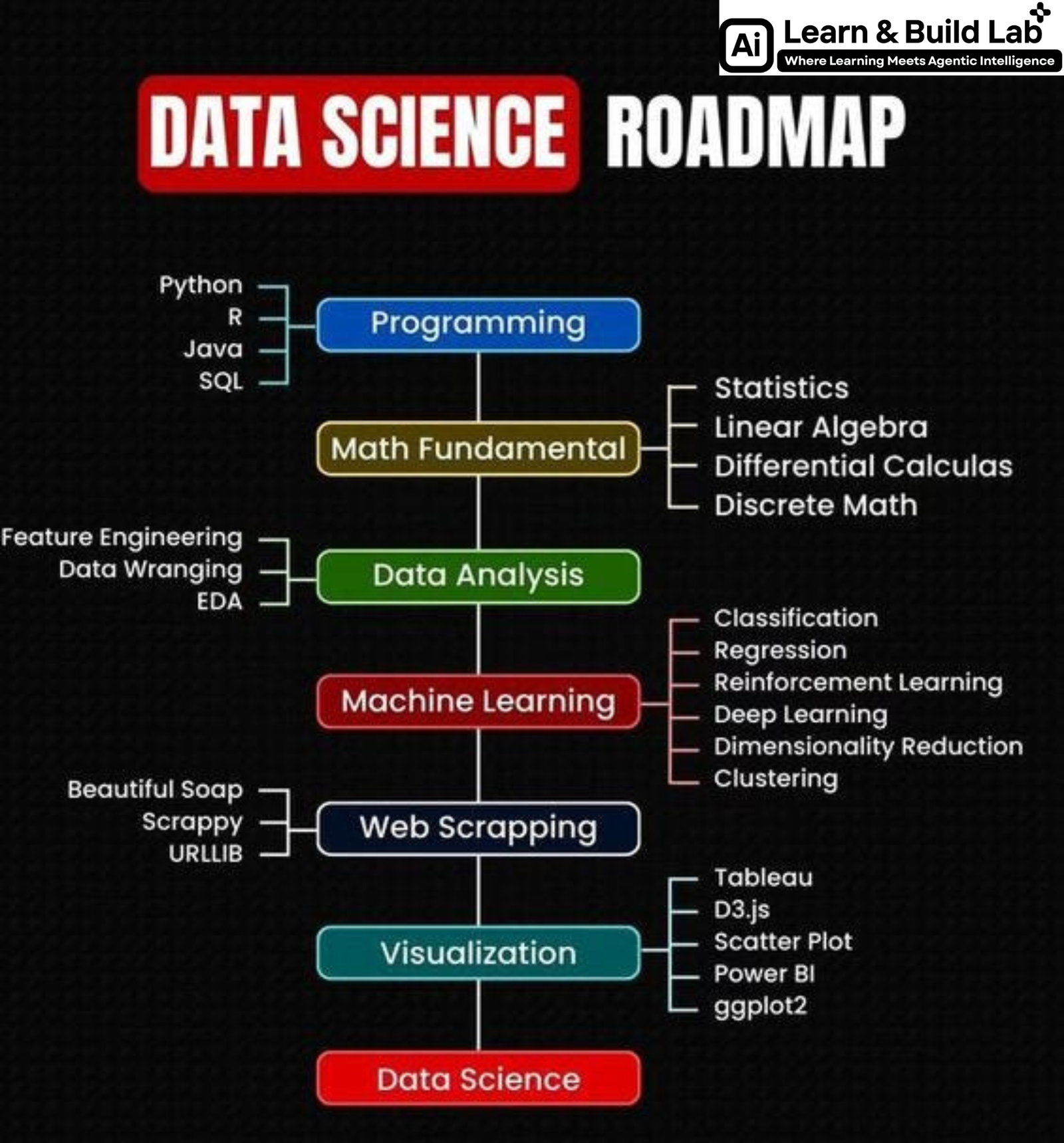
Data Science is one of the most in-demand and high-growth career paths today. However, many students and professionals feel confused about where to start, what to learn, and in what sequence. This is where a clear Data Science roadmap becomes essential.
In this blog, you’ll get a complete, beginner-to-advanced Data Science roadmap, covering skills, tools, projects, and career roles—written in simple, crystal-clear language and fully SEO-optimized.
What Is a Data Science Roadmap?
A Data Science roadmap is a structured learning path that guides you step by step from beginner level to professional Data Scientist. It helps you avoid confusion, save time, and focus only on industry-relevant skills.
A proper roadmap answers:
- What to learn first
- Which tools are required
- How much depth is needed
- When to start projects
- How to become job-ready
Step 1: Foundation – Mathematics & Statistics
You don’t need advanced mathematics, but basic concepts are essential.
Focus on:
- Mean, Median, Mode
- Variance & Standard Deviation
- Probability basics
- Correlation & Regression
- Data distribution
👉 This foundation helps you understand data behavior and model logic.
Step 2: Programming for Data Science (Python)
Python is the core programming language for Data Science due to its simplicity and powerful libraries.
Learn:
- Python basics (loops, functions, data types)
- NumPy for numerical computing
- Pandas for data analysis
- Data cleaning & preprocessing
Key goal: Be comfortable handling real datasets.
Step 3: SQL & Databases
Most real-world data lives in databases. SQL is mandatory for Data Science jobs.
Learn:
- SELECT, WHERE, JOIN, GROUP BY
- Subqueries
- Database concepts
- Data extraction for analysis
👉 SQL + Python together make you industry-ready.
Step 4: Data Analysis & Exploratory Data Analysis (EDA)
This is where Data Science becomes practical.
Learn:
- Data cleaning techniques
- Handling missing values
- Outlier detection
- Exploratory Data Analysis (EDA)
- Insights & pattern discovery
Tools used:
- Pandas
- Matplotlib
- Seaborn
Step 5: Data Visualization & Business Intelligence
Data Scientists must explain insights clearly to non-technical stakeholders.
Learn:
- Charts & dashboards
- Storytelling with data
- Business KPIs
- Power BI or Tableau
Visualization skills increase your job value significantly.
Step 6: Machine Learning Fundamentals
Machine Learning is the core of Data Science.
Start with:
- Supervised vs Unsupervised Learning
- Linear & Logistic Regression
- Decision Trees
- Random Forest
- K-Means Clustering
- Model evaluation
Goal: Understand concepts + apply them practically, not just theory.
Step 7: Advanced Data Science & AI Concepts
Once fundamentals are clear, move to advanced topics:
- Feature engineering
- Model optimization
- Cross-validation
- Basic Deep Learning
- NLP fundamentals
- Recommendation systems
This stage separates Data Analysts from Data Scientists.
Step 8: Real-World Projects & Case Studies
Projects are the most important part of the Data Science roadmap.
Work on:
- Sales forecasting
- Customer churn analysis
- Fraud detection
- Marketing analytics
- Business dashboards
Projects show employers that you can solve real problems, not just complete courses.
Step 9: Deployment & Tools Used in Industry
Learn how models are used in real companies:
- Git & GitHub
- Model deployment basics
- APIs
- Cloud fundamentals (optional)
This step makes you production-ready.
Step 10: Career Roles After Following This Roadmap
After completing the Data Science roadmap, you can apply for:
- Data Analyst
- Business Analyst
- Junior Data Scientist
- Machine Learning Engineer
- AI Analyst
With experience, you can grow into senior and leadership roles.
Is This Data Science Roadmap Suitable for Non-IT Students?
Yes. This roadmap is perfect for non-IT and career-switchers. Many successful Data Scientists come from mechanical, civil, commerce, and science backgrounds.
What matters most:
- Consistency
- Practice
- Mentorship
- Projects