





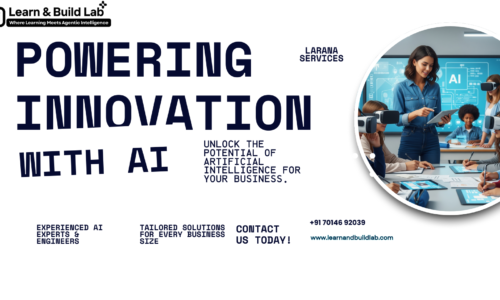
Powering Innovation with AI: How Artificial Intelligence Is Shaping the Future (2025 Guide)
Artificial Intelligence (AI) is no longer a future concept—it is already transforming how we learn, work, and innovate. From smart applications and automation to data-driven decision-making, AI is powering innovation across industries. In 2025, understanding AI is essential for students, professionals, and businesses who want to stay ahead in a competitive digital world.
At Learn & Build Lab, we focus on teaching Artificial Intelligence in a practical, easy-to-understand, and industry-relevant way, helping learners unlock the true potential of AI.
This blog explains how AI drives innovation, where it is used, what skills are required, and why learning AI today is one of the smartest career decisions.
What Does “Powering Innovation with AI” Mean?
Powering innovation with AI means using Artificial Intelligence to create smarter solutions, improve efficiency, and solve real-world problems in new and better ways. AI enables systems to analyze data, learn patterns, and make intelligent decisions that were earlier only possible through human effort.
Innovation powered by AI helps organizations:
-
Automate complex processes
-
Improve accuracy and speed
-
Create personalized experiences
-
Predict future trends
-
Reduce operational costs
AI does not replace innovation—it accelerates it.
How Artificial Intelligence Drives Innovation
AI drives innovation by combining data, algorithms, and computing power to generate insights and actions.
Key ways AI powers innovation:
-
Turning data into knowledge
-
Automating repetitive tasks
-
Enhancing creativity with smart tools
-
Improving decision-making
-
Enabling predictive and intelligent systems
Core Technologies Behind AI Innovation
Artificial Intelligence is built on multiple technologies that work together.
Table 1: Core AI Technologies
| Technology | Role in Innovation |
|---|---|
| Machine Learning | Enables systems to learn from data |
| Deep Learning | Solves complex problems using neural networks |
| Natural Language Processing | Understands and processes human language |
| Computer Vision | Analyzes images and videos |
| AI Automation | Reduces manual effort and errors |
At Learn & Build Lab, students are introduced to these technologies with hands-on projects rather than just theory.
AI Innovation in Education
AI is transforming education by making learning more personalized, flexible, and effective.
How AI improves education:
-
Personalized learning paths
-
Smart assessments and analytics
-
AI-powered tutoring systems
-
Faster evaluation and feedback
-
Skill-based learning models
This is why modern education platforms like Learn & Build Lab focus on AI-driven learning approaches that prepare students for real-world challenges.
AI Innovation in Business and Industry
Businesses are using AI to gain a competitive advantage.
Table 2: AI Use Cases in Business
| Industry | AI Innovation Example |
|---|---|
| Marketing | AI-powered targeting and analytics |
| Healthcare | Disease prediction and diagnostics |
| Finance | Fraud detection and risk analysis |
| Manufacturing | Predictive maintenance |
| IT Services | Intelligent automation |
AI enables businesses to make faster, smarter, and data-backed decisions.
Why AI Is Essential for Future Careers
AI is not limited to one job role. It is becoming a core skill across multiple professions.
Career benefits of learning AI:
-
High demand and job security
-
Opportunities across industries
-
Global career scope
-
Strong salary growth
-
Freelancing and startup opportunities
AI-skilled professionals are preferred because they can innovate, automate, and optimize systems.
Skills Required to Work with AI
You don’t need to be a genius to learn AI. With the right guidance, anyone can start.
Table 3: Essential AI Skills
| Skill | Level Required |
|---|---|
| Logical Thinking | Basic |
| Programming (Python/Java) | Beginner–Intermediate |
| Data Understanding | Basic |
| Problem Solving | Strong |
| Curiosity to Learn | Most Important |
At Learn & Build Lab, we help beginners build these skills step by step.
AI Innovation and Automation
One of the biggest advantages of AI is automation. AI-powered automation reduces human effort and increases productivity.
Benefits of AI automation:
-
Saves time
-
Reduces errors
-
Improves efficiency
-
Scales easily
-
Enhances accuracy
This is why AI automation is becoming a key part of modern businesses and tech careers.
Why Learn AI at Learn & Build Lab
At Learn & Build Lab, our approach to AI education is practical and career-focused.
What makes us different:
-
Beginner-friendly learning path
-
Real-world AI projects
-
Industry-experienced mentors
-
Focus on innovation and problem-solving
-
Career guidance and support
Discover how Artificial Intelligence is powering innovation across education, business, and careers. Learn AI skills with practical guidance from Learn & Build Lab. Visit: https://learnandbuildlab.com (use your actual page link)
Future Scope of AI Innovation
The future of AI is extremely promising. AI will continue to shape:
-
Smart cities
-
Autonomous systems
-
Healthcare innovation
-
Advanced education platforms
-
Business intelligence systems
AI innovation will create new job roles, new industries, and new opportunities.
Conclusion
Artificial Intelligence is powering innovation across every sector of the modern world. From education and business to healthcare and technology, AI is helping humans think smarter, work faster, and innovate better.
Learning AI today means preparing for tomorrow’s opportunities. With the right guidance and practical exposure, anyone can build a successful future in AI.
Learn & Build Lab is committed to helping learners understand, apply, and innovate with Artificial Intelligence.
Frequently Asked Questions (FAQs)
1. What does powering innovation with AI mean?
It means using AI to create smarter and more efficient solutions.
2. Is AI only for IT students?
No, AI can be learned by students from any background.
3. How does AI help businesses innovate?
AI improves automation, decision-making, and efficiency.
4. Is AI difficult to learn?
With proper training, AI is easy for beginners.
5. What industries use AI innovation?
Education, healthcare, finance, IT, marketing, and more.
6. Does AI replace human jobs?
AI supports humans and creates new job opportunities.
7. What skills are needed to learn AI?
Basic logic, programming, and problem-solving skills.
8. Is AI a good career in 2025?
Yes, AI is one of the most in-demand career paths.
9. How long does it take to learn AI basics?
Around 2–4 months with regular practice.
10. Does Learn & Build Lab teach AI for beginners?
Yes, with practical projects and expert mentorship.
Instructor

Popular Courses


Popular Courses