






Introduction: Why You Need a Structured Java Roadmap
Java is one of the most trusted and widely used programming languages in the software industry. From enterprise applications and backend systems to web development and APIs, Java continues to dominate the job market.
However, many learners struggle because they learn Java in a random, unstructured way. A clear Java roadmap helps you move step by step—from basics to advanced concepts—without confusion.
This Java Detailed Roadmap is designed for students, freshers, and career switchers who want to build strong Java fundamentals and become industry-ready developers.
1. Java Basics – Building the Foundation
The first step in the Java roadmap focuses on understanding how Java works and setting up the development environment.
You begin by installing the JDK and configuring an IDE such as IntelliJ IDEA or Eclipse. After that, you learn the famous Hello World program, which introduces Java syntax and execution flow.
This stage also covers data types, variables, constants, operators, and control statements like if-else and switch. Loops such as for, while, and do-while help you build logic. Input and output handling using Scanner and System.out completes the foundation.
2. Object-Oriented Programming (OOP) in Java
OOP is the backbone of Java development. In this phase, you learn how Java models real-world problems using classes and objects.
You understand constructors (default and parameterized), the this and super keywords, and core OOP pillars like inheritance, polymorphism, abstraction, and encapsulation. Interfaces and abstract classes are also covered to prepare you for real enterprise applications.
Mastering OOP is essential to crack Java interviews and build scalable software.
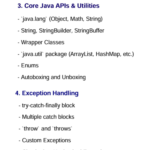
3. Core Java APIs and Utilities
Once OOP concepts are clear, the roadmap moves to Core Java APIs that developers use daily.
You learn about the java.lang package, including Object, String, and Math classes. Topics like StringBuilder vs StringBuffer, wrapper classes, enums, and autoboxing/unboxing help you understand how Java manages data internally.
The java.util package, including ArrayList, HashMap, and other utilities, plays a major role in real projects.
4. Exception Handling in Java
Exception handling makes your applications stable and error-free.
This section covers try-catch-finally blocks, multiple catch blocks, the throw and throws keywords, and custom exceptions. You also learn the difference between checked and unchecked exceptions, which is a frequently asked interview topic.
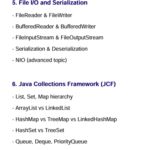
5. File I/O and Serialization
Java applications often deal with files and data storage. This part of the roadmap introduces FileReader, FileWriter, BufferedReader, BufferedWriter, and file streams.
You also learn serialization and deserialization, which are used to store and transfer objects. Advanced learners explore Java NIO for high-performance file operations.
6. Java Collections Framework (JCF)
The Java Collections Framework is one of the most important areas for interviews and real-world development.
You study List, Set, and Map hierarchies, differences between ArrayList and LinkedList, HashMap vs TreeMap vs LinkedHashMap, and HashSet vs TreeSet. Sorting and comparison using Comparable and Comparator are also covered.
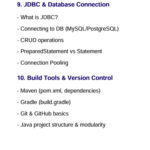
7. JDBC and Database Connectivity
To build real applications, Java must connect with databases. This stage introduces JDBC, database connections with MySQL or PostgreSQL, and CRUD operations.
You learn about PreparedStatement vs Statement, SQL injection prevention, and connection pooling, which is crucial for performance.
8. Build Tools and Version Control
Modern Java development relies on build tools and collaboration.
You learn Maven (pom.xml) and Gradle (build.gradle) to manage dependencies and project structure. Git and GitHub basics help you manage source code and work in teams.
9. Web Development with Java
This stage introduces Java web development concepts.
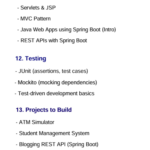
You start with Servlets and JSP, understand the MVC architecture, and move toward Spring Boot basics. REST API development using Spring Boot prepares you for backend developer roles.
10. Testing in Java
Testing ensures code quality. This phase covers JUnit, Mockito, and test-driven development (TDD) basics.
Understanding testing frameworks makes you stand out as a professional Java developer.
11. Projects to Build (Most Important Step)
Projects turn knowledge into skills. As part of this Java roadmap, you should build:
- ATM Simulator
- Student Management System
- Blogging REST API using Spring Boot
These projects strengthen your resume, GitHub profile, and interview confidence.
Final Thoughts: Follow the Roadmap, Not Random Tutorials
This Java Detailed Roadmap provides a clear path from beginner to job-ready Java developer. If you follow these steps in order and practice consistently, you will build strong fundamentals, real-world skills, and career confidence.