






Introduction: Why a Java Cheat Sheet Is Essential
Java is one of the most powerful and widely used programming languages in the world. From web applications to enterprise systems, Android apps, and backend services, Java is everywhere.
A Java cheat sheet helps learners quickly revise core concepts, understand syntax, and recall important topics during:
- Exams
- Interviews
- Coding practice
- Project development
This page covers Java from basics to advanced, explained in simple and clear language.
1. Basic Structure of a Java Program
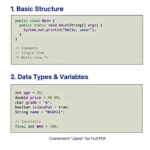
Every Java program follows a fixed structure.
Key Points:
classdefines the program structuremain()is the entry point- Code execution starts from
main()
Why It Matters:
Understanding program structure is essential before moving to logic or advanced concepts.
2. Data Types & Variables in Java
Java supports primitive and non-primitive data types.
Common Data Types:
int– integersdouble– decimal valueschar– single characterboolean– true/falseString– text data
Constants:
Using final keyword makes variables constant.
Why It Matters:
Correct data type usage improves performance, memory management, and code clarity.
3. Operators & Control Flow
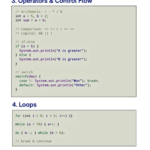
Java provides operators to perform operations and control execution.
Types of Operators:
- Arithmetic (
+ - * / %) - Comparison (
== != > < >= <=) - Logical (
&& || !)
Control Statements:
if-elseswitch
Why It Matters:
Control flow helps Java programs make decisions and execute logic correctly.
4. Loops in Java
Loops help execute code repeatedly.
Loop Types:
forloopwhileloopdo-whileloop
Additional Keywords:
breakcontinue
Why It Matters:
Loops are used heavily in data processing, collections, and algorithms.
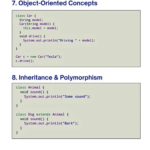
5. Object-Oriented Concepts (OOP)
Java is a pure object-oriented programming language.
Core OOP Concepts:
- Class & Object
- Encapsulation
- Abstraction
- Inheritance
- Polymorphism
Why It Matters:
OOP makes Java programs modular, scalable, and maintainable.
6. Inheritance & Polymorphism
Inheritance:
Allows a class to acquire properties of another class using extends.
Polymorphism:
Method overriding enables one method to behave differently based on object type.
Why It Matters:
Used heavily in frameworks, real-world applications, and enterprise software.
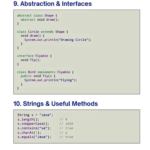
7. Abstraction & Interfaces
Abstraction:
Achieved using abstract classes.
Interfaces:
Used to achieve multiple inheritance and define contracts.
Why It Matters:
Abstraction improves security, design clarity, and loose coupling.
8. Strings & Useful Methods
Strings are immutable objects in Java.
Common String Methods:
length()toUpperCase()contains()charAt()equals()
Why It Matters:
String manipulation is essential in input handling, validation, and text processing.
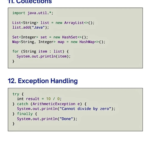
9. Java Collections Framework
Collections store and manipulate groups of objects.
Common Interfaces:
List(ArrayList)Set(HashSet)Map(HashMap)
Why It Matters:
Collections are widely used in real-world projects, APIs, and backend logic.
10. Exception Handling in Java
Exceptions handle runtime errors gracefully.
Keywords:
trycatchfinally
Why It Matters:
Prevents program crashes and improves application reliability.
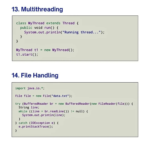
11. Multithreading in Java
Multithreading allows multiple tasks to run simultaneously.
Key Concepts:
Threadclassrun()methodstart()method
Why It Matters:
Used in high-performance, real-time, and scalable applications.
12. File Handling in Java
Java supports file operations using java.io package.
Common Classes:
FileFileReaderBufferedReader
Why It Matters:
Essential for data storage, logs, and file-based applications.
Who Should Use This Java Cheat Sheet?
✔ Java beginners
✔ College students
✔ Job aspirants
✔ Interview preparation
✔ Developers revising core Java
Conclusion
This Java Cheat Sheet provides a complete overview of Java fundamentals to advanced concepts in one place. Mastering these topics builds a strong foundation for careers in software development, backend engineering, and enterprise applications.