





Introduction to AI and Machine Learning
Artificial Intelligence (AI) and Machine Learning (ML) are two of the most powerful and fast-growing technologies shaping the modern digital world. From smartphones and recommendation systems to self-driving cars and medical diagnosis, AI and ML are everywhere.
Artificial Intelligence refers to the ability of machines to mimic human intelligence, such as thinking, learning, problem-solving, and decision-making. Machine Learning is a subset of AI that enables machines to learn automatically from data without being explicitly programmed.
This blog explains AI and Machine Learning from fundamentals to advanced concepts, making it ideal for beginners, students, and professionals.
What is Artificial Intelligence (AI)?
Artificial Intelligence is a branch of computer science focused on creating intelligent machines capable of performing tasks that typically require human intelligence.
Key capabilities of AI:
- Learning from experience
- Understanding language
- Recognizing images and speech
- Making decisions
- Solving complex problems
AI systems are designed to simulate human behavior using data, algorithms, and computational models.
What is Machine Learning (ML)?
Machine Learning is a core part of AI that allows systems to automatically learn patterns from data and improve performance over time.
Instead of writing fixed rules, ML models:
- Analyze data
- Identify patterns
- Learn relationships
- Make predictions or decisions
Machine Learning powers applications such as spam detection, recommendation engines, stock prediction, and facial recognition.
Types of Machine Learning
1. Supervised Learning
Supervised learning uses labeled data, where the correct output is already known.
Examples:
- Predicting house prices
- Email spam detection
- Disease diagnosis
Common algorithms:
- Linear Regression
- Logistic Regression
- Decision Trees
- Support Vector Machines
2. Unsupervised Learning
Unsupervised learning works with unlabeled data to discover hidden patterns and structures.
Examples:
- Customer segmentation
- Market basket analysis
- Anomaly detection
Common algorithms:
- K-Means Clustering
- Hierarchical Clustering
- Principal Component Analysis (PCA)
3. Reinforcement Learning
Reinforcement learning teaches machines to learn through trial and error using rewards and penalties.
Key concepts:
- Agent
- Environment
- Reward
- Policy
Applications:
- Game playing AI
- Robotics
- Autonomous vehicles
Deep Learning and Neural Networks
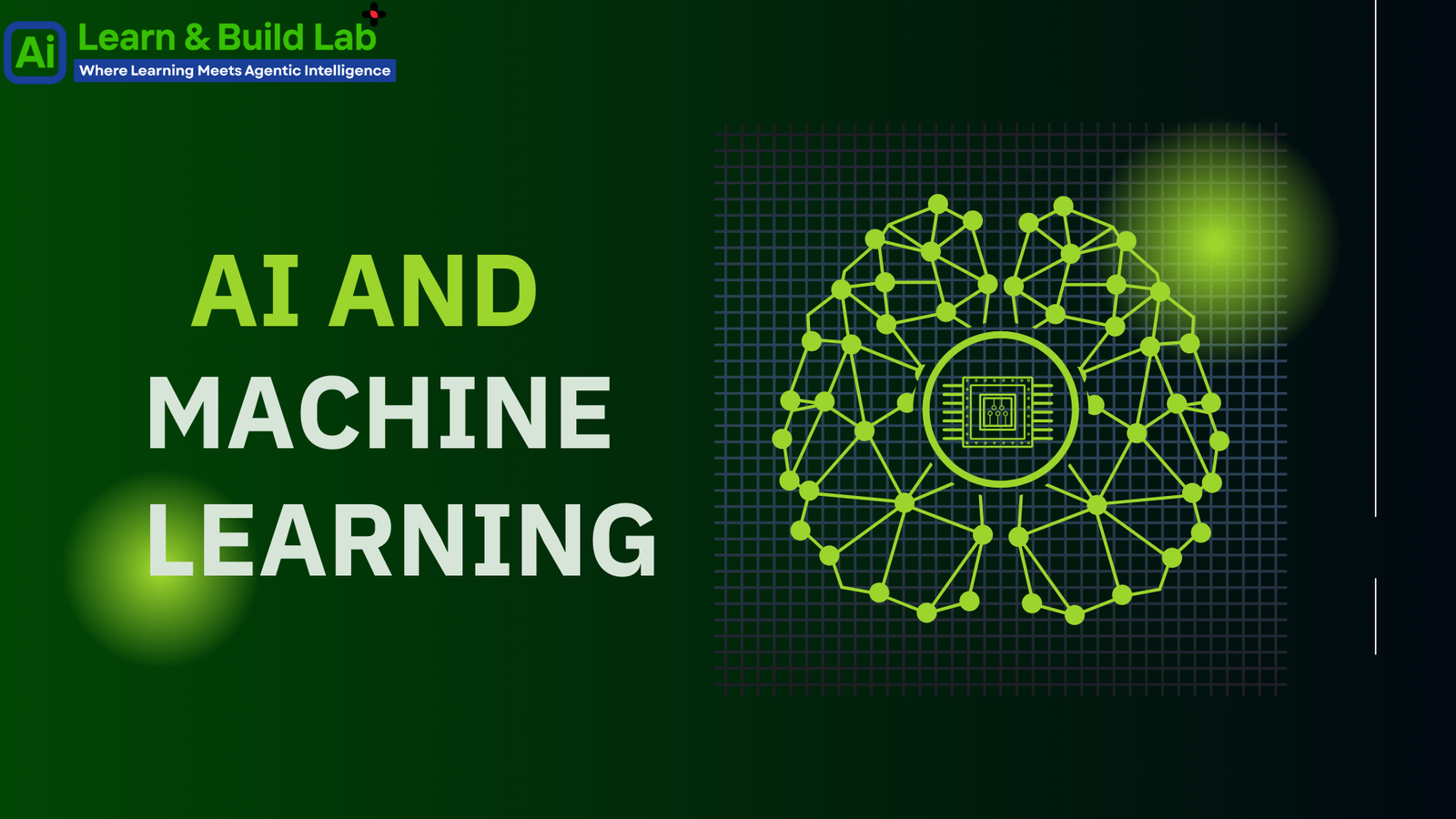
Deep Learning is an advanced branch of Machine Learning that uses artificial neural networks with multiple layers.
These networks are inspired by the human brain and are capable of handling complex tasks like:
- Image recognition
- Speech recognition
- Natural language understanding
Core components:
- Neural Network Structure
- Forward Propagation
- Backpropagation
- Activation Functions
Deep learning has revolutionized modern AI systems.
Natural Language Processing (NLP)
Natural Language Processing enables machines to understand and generate human language.
Key NLP applications:
- Machine Translation
- Sentiment Analysis
- Text Summarization
- Chatbots and Virtual Assistants
NLP plays a major role in search engines, customer support automation, and content analysis.
Computer Vision and Image Recognition
Computer Vision allows machines to analyze and understand visual data from images and videos.
Major use cases:
- Object Detection
- Facial Recognition
- Image Classification
- Video Surveillance
Computer Vision is widely used in healthcare, security systems, manufacturing, and autonomous vehicles.
Real-World Applications of AI and Machine Learning
AI and ML are transforming multiple industries:
Healthcare
AI assists in disease detection, medical imaging, drug discovery, and personalized treatment.
Finance
Used for fraud detection, credit scoring, algorithmic trading, and risk analysis.
E-commerce
Recommendation systems, demand forecasting, and customer behavior analysis.
Autonomous Vehicles
Self-driving cars use AI for navigation, decision-making, and safety.
Future of AI and Machine Learning
The future of AI and Machine Learning is extremely promising. With advancements in deep learning, generative AI, robotics, and agentic systems, AI will continue to reshape industries and create new career opportunities.
AI will focus more on:
- Human-AI collaboration
- Ethical AI
- Automation with intelligence
- Smarter decision-making systems
Learning AI and ML today is an investment in a future-ready career.
Why Learn AI and Machine Learning?
- High demand across industries
- Excellent career growth
- Versatile skill set
- Opportunity to work on cutting-edge technology
At Learn & Build Lab, AI and ML are taught with a strong focus on concept clarity, real-world use cases, and future technologies.
Conclusion
AI and Machine Learning are no longer optional skills—they are essential for the future of technology. Understanding their fundamentals, algorithms, applications, and future scope opens doors to innovation and career growth.
Whether you are a beginner or a professional, mastering AI and Machine Learning will empower you to build intelligent solutions for real-world problems.